Back to Main
How Much of the Internet Flows Through Northern Virginia? An Excessively Deep Dive.
By Camilo Calvo-Alcañiz. 10-minute read. February 21, 2026.

On a snowy evening in Washington, D.C., several years back, I was asked a question about Virginia that stuck with me.
It was trivia night at a bar, a high holiday for the city’s consultants, Hill staffers, and other moustachioed young men and their girlfriends. The trivia, hosted by a University of Virginia grad, included a round dedicated to questions about the Mother of Presidents state—and the following Virginia-themed question’s answer appeared to me to defy all common sense:
Q: How much of the world’s internet traffic flows through Northern Virginia?
A: 70%
My team’s guess of 20% was way off the mark. But knowing a bit about the internet’s infrastructure, that 70% figure just didn’t seem possible. The majority of the websites people use in their day-to-day lives—Google, Facebook, Reddit—maintain fleets of data centers that are geographically distributed across the United States and the world. To reduce latency, a user scrolling Instagram in Portland, Oregon would be served from Meta’s Prineville data center, while the same user on vacation in Hamburg, Germany would be served from Meta’s Odense, Denmark, data center. And in fact, Meta doesn’t even have a data center in Northern Virginia!
So then, was this figure a holdover from the pre-cloud, pre-content delivery network world? Was it true in the dial-up era, or even earlier? Maybe Virginia’s homespun industries of intelligence and defense were resource intensive enough to constitute 70% of the internet’s traffic. Or maybe this was all marketing, smoke and mirrors from the Virginia tourism board, an urban myth that was just technical and dry enough to go unscrutinized until someone, incensed by missing an unfair trivia question, sought to uncover its validity.
I began to dig.
Origins of the 70% Figure
If you search for the phrase “70% of the internet Northern Virginia,” you get a mixed bag. Some of the top hits are refutations, such as this article by Tim Stronge. Other results—typically corporate blog posts or dispatches from Virginia business orgs—repeat the claim without citing any sources. Google’s AI Overview tool, dutifully agreeing with the premise you provided it, offers this:
Northern Virginia, specifically Loudoun County’s “Data Center Alley” in Ashburn, is widely cited as the world’s largest data center hub, with industry estimates suggesting up to 70% of global internet traffic passes through this area daily.
Of all of the above, Tim Stronge’s article is the only one that provides any hard data. Looking at internet capacity, data centers, and cloud availability zones, he finds that the D.C. metro area can’t account for more than 40% of national traffic in any category. He also notes that internet traffic patterns haven’t changed much since 2010, meaning it’s unlikely the 70% figure has been true any time in the past 15 years.
These numbers confirm my suspicion that the official trivia answer was incorrect (meaning I should get those points back). But it doesn’t mean that the 70% figure was never true. After all, Tim limited his analysis to the past 15 years of the internet, a period of marked stability compared to the 15 that preceded it. Doesn’t the internet of 2010, with its Facebook, Google, and YouTube, bear much more resemblance to today than 1995, with its America Online (AOL), Netscape, and WorldCom? It’s still possible that the 70% figure was a high-water mark from the early days of the internet, when the web was associated with Virginia as much as with Silicon Valley.
It was also easier for Northern Virginia to capture 70% of internet traffic in the ‘90s because of how dominant the U.S. market was compared to the rest of the world:
- In 1996, the U.S. comprised over half of the world’s internet users, compared with less than 10% today. [1]
- In 1997, the U.S. still had the majority of the world’s internet servers. [2]
I hoped that this meant there was a primary source from the ‘90s that explicitly mentioned the 70% figure. But there was no such source because the figure is only a decade old.

Loudoun County? More Like Lies(-doun) County.
Most articles I found repeating the 70% claim cite this 2016 Washingtonian article about Loudoun County’s “Data Center Alley:”
An estimated 70 percent of the world’s web traffic—streaming video, financial transactions—flows through the colorful insides of these windowless buildings.
The only reference to the figure that predates the Washingtonian article is from the Loudoun County Department of Economic Development’s website. It highlights the talking points from a 2015 conference called “How Data Centers Create Business Opportunities,” including a caption that wins the prize for the earliest mention of the statistic:
Loudoun County is a global leader in the data center industry, with 9 million square feet of space and more than 70% of the world’s internet coursing through the networks of its companies.
Funnily enough, one of the speakers at this conference was Buddy Rizer, the executive director for economic development in Loudoun County. Why is that funny? Well, Buddy Rizer is also one of two primary sources in the Washingtonian article, the second-ever source to use the 70% figure. And then there’s this LinkedIn post:
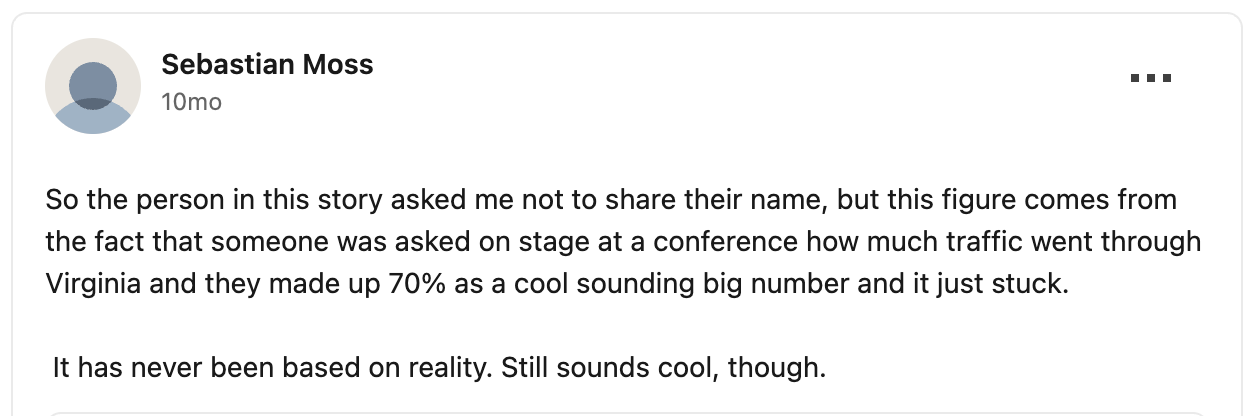
With that, we have sufficient evidence to conclude that this figure was made up because it sounded like an impressive number. I don’t blame Buddy for this. There’s little that’s more human than saying something cool but fictional at a conference and then doubling down on it later to a local journalist. In a way, it’s like he was trying to speak the 70% figure into existence. And with how many people believed him, you could argue he succeeded.
Why Half of the Internet Actually Did Flow Through Northern Virginia
However, even after finding the source of the 70% figure, I wasn’t ready to end my investigation. During my research, it seemed pretty clear to me that at some point in the early 2000s, the majority of the internet actually was flowing through Northern Virginia. One notable clue was this Reddit comment under a post discussing the 70% myth:

As we’ve established above, the 70% figure didn’t exist before 2015. But before that, the internet was littered with references to half of the internet flowing through Northern Virginia: U.S. News, Time, and even keynote speeches from the late ‘90s all mention it. And Reddit user looktowindward appears to know what lies at the heart of this: AOL. (looktowindward did not respond when asked for a comment.)
At its peak during the early 2000s, AOL dominated the World Wide Web. As the nation’s largest internet service provider (ISP), it acted as a middleman between users and the websites they wanted to access. It was also a part of the old guard of internet companies based in the D.C. metro area, drawn there by the surplus of fiber-optic cable and proximity to the tech-hungry intelligence and defense industries. Originally headquartered in Tyson’s Corner, VA, it eventually moved its offices and data centers to then-rural Loudoun County, in what is now the heart of Data Center Alley.
For half of all internet traffic to have flowed through Northern Virginia, we just need two things to be true. The first is that AOL must have routed all of its traffic through its Northern Virginia data centers. The second is that AOL’s share of internet traffic needed to have peaked at near 50%.
For the first statement, we can use the AOL Webmaster website, which contains technical details about AOL’s network. Although the website’s server has long been unplugged (or demolished), we can still access it using the Internet Archive. There, we find this invaluable piece of information from the “Connectivity info” page:
A member connects to the America Online Internet Access Service through one of three major paths [sic]: AOLnet TCP/IP network or Third party TCP/IP access provider. With each connection type, the AOL client software communicates with the AOL host complex, located in Northern Virginia, using a proprietary session protocol.
This supports Reddit user looktowindward’s claim that all AOL customers were routed through the data centers in Dulles, VA (the DTC) and Manassas, VA (the MTC) in Loudoun and Prince William counties, respectively.
Next, I needed information on AOL’s usership at its peak. I was getting pretty tired of sitting at home digging through Internet Archive snapshots, so I dug up my Library of Congress library card, got in my car, and drove across town to Capitol Hill. AOL’s history may have been wiped off the internet, but I figured a juggernaut of that size would have left a sizable paper trail. And frankly, the only library that would care to stock books about AOL was the one that held nearly every book in existence.

I checked out two books to further my research. One was Designing ISP Architectures, written in 2002, which would help me understand the standard of practice at the time. The other, It’s a Wired, Wired World: Business the AOL Way, was a glowing business profile of AOL written in 2001. I hoped this one would have some hard numbers on AOL’s user base. And sure enough, the introduction had some valuable stats, including this one:
Almost 40% of the time that all Americans spend on the Web is spent within the friendly confines of AOL content and services.
Even better, the book had a notes section after each chapter with a bibliography. I excitedly flipped to it, only to see this:
Compiled from numerous reports.
There was no mention of what these “numerous reports” were. Seeing other references to the 40% figure online, I decided to take this one at its word rather than go down the rabbit hole of searching for yet another figure’s source.
With the two figures above, we have 40% of the nation’s internet flowing through Northern Virginia. All we need is another 10%. Adding up traffic from other ISPs headquartered in Loudoun County (such as MCI WorldCom and UUNet, both in Ashburn, VA) and significant internet exchange points (such as MAE East, which was based in D.C., Fairfax County, VA, and Ashburn, VA), we get what looks like over half of the internet. Seems like the figure was true.
However, this is a bit anticlimactic, isn’t it? I was hoping to find a definitive source for where the 50% figure came from, just like with the 70% figure. But given the spotiness of data from the early internet, it doesn’t look like there’s any publicly available proof for this claim besides looktowindward’s comment about a measurement in 2001.
So maybe it was this: Say you were an AOL employee in the early 2000s, and you knew 40% of the nation’s traffic flowed through your two data centers. You stand out in Loudoun County and look around. WorldCom over there, MAE East over there. Everywhere you look there’s internet money and fiber optic cable. Yeah, half of the internet is here. Why not?
(To the bar that originally used this trivia question, if you’re reading this, please answer my emails about this very important subject. Thank you.)